Terrestrial giants are rocky planets that are much larger than Earth but retain a solid, rocky composition rather than becoming gas giants like Jupiter or Saturn. They could be several times Earth’s mass but are still smaller and less dense than the giant gaseous planets.
Terrestrial giants have a much greater mass than Earth (often 5–10 times the mass of Earth or more). This large mass leads to stronger gravity and could affect planetary atmospheres and geology.
Habitability Potential
Terrestrial giants in the habitable zone of their stars are particularly interesting for exoplanet research, as they might support thick, stable atmospheres and, potentially, liquid water. The size and atmosphere could create environments that sustain life forms adapted to stronger gravity.
It made primarily of rock and metal, similar to Earth, Mars, Venus, and Mercury.
MERCURY
The closest planet to the Sun
It is an intriguing world with some of the most extreme conditions in our solar system.
Mercury’s surface is covered in long, curving cliffs called scarps, some stretching hundreds of kilometer. These features formed as the planet’s core cooled and contracted over time.
Polar Ice
Despite its scorching daytime temperatures, Mercury has water ice hidden in permanently shadowed craters at its poles. These areas never receive sunlight, allowing ice to persist, likely brought by comets or formed by solar interactions over time.
Internal Structure
Core: Mercury has a large metallic core, making up about 85% of its radius. This core is partly molten, which generates a weak magnetic field.
Unique Features
Mercury’s close proximity to the Sun and its slow rotation make it a fascinating, harsh environment, showcasing the extremes of planetary geology and physics.
VENUS
The Hottest Rocky Planet in the Solar System
Venus is the second planet from the Sun and one of the most extreme worlds we know. Although it is almost the same size as Earth, the two planets could not be more different. Venus is wrapped in thick clouds and intense heat, creating a harsh environment. Despite this, it remains one of the most fascinating planets to explore.
A Harsh and Fiery World
The atmosphere of Venus is filled with carbon dioxide and covered by thick clouds of acid. This traps enormous heat, making Venus the hottest planet in the Solar System. Its surface has no water, very little wind, and landscapes shaped by volcanoes. It is a world permanently locked in an extreme greenhouse effect.
Earth’s Twin, Yet Nothing Alike
Even though Venus and Earth share similar size and structure, their paths are very different. Earth supports life, but Venus has become an environment too hostile for survival. Studying Venus helps scientists understand how climate can transform a planet over time. It is a dangerous, mysterious, and surprisingly important world.
Mars
The Mysterious Red Planet
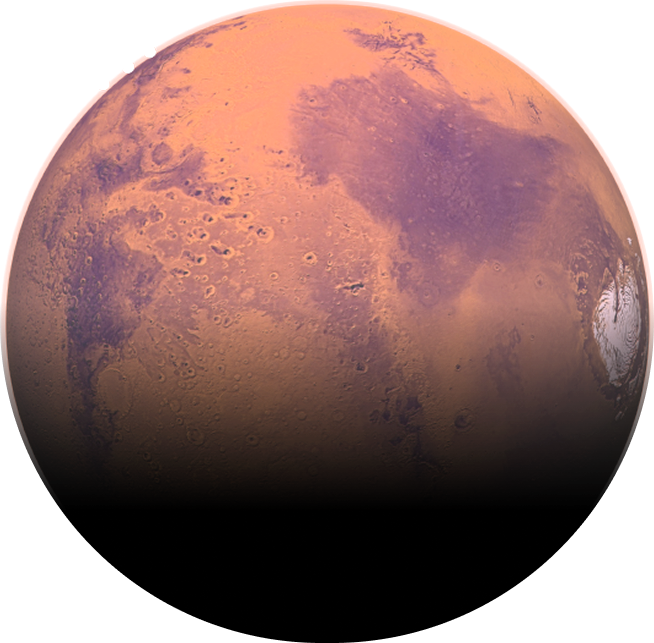
Mars is the fourth planet from the Sun and is known as the Red Planet because of its rusty surface.
It is smaller than Earth and has thin, cold air mostly made of carbon dioxide.
Mars has huge mountains and deep valleys, including Olympus Mons, the tallest volcano in the solar system.
Scientists study Mars to learn if it once had water or life.
Mars has a thin atmosphere, making it very cold. Huge volcanoes and valleys show that it was once more active.
Scientists study Mars for clues about water and past life. It is also a main target for future human missions.